




by Christine Stebbins
Scott Brix, president of the Food Shed board & co-founder, led an engaging conversation on today’s mega food system at Green Drinks, an event organized by the Environmental Defenders of McHenry County and Duke’s Alehouse in Crystal Lake earlier this month.
It was an opportunity for community residents—passionate about the local food community and the environment—to gather and learn more about the global food system that feeds over 8 billion people every day and the local food movement in McHenry County.
Scott, who has spent more than 40 years working inside the mainstream global food industry as a food scientist and business leader, now resides in rural Marengo. He co-founded the Food Shed Co-op that opened two years ago in McHenry County, with a mission to promote healthy food choices, strengthen the local economy, and champion environmentally sustainable farming.
During the event, Scott shared his perspectives on food which he describes as “one of our most important environmental relationships.”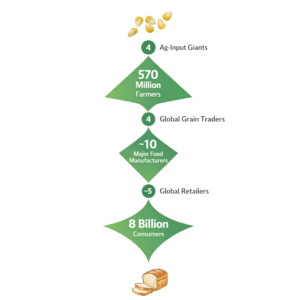
The Global Food System
In many ways it begins in the U.S. Corn Belt, one of the most productive agricultural areas on earth, he said. Corn and soybean fields dominate our landscape, crops that are turned into thousands of food ingredients, starch to make biofuels, and feed for livestock. Industrial farmers buy seeds and fertilizers and sell what they grow to a handful of global grain traders—ADM, Bunge, Cargill, Louis Dreyfus. They in turn sell their products to Nestle, PepsiCo, Kraft-Heinz and other big food processors, which then sell to retailers like Walmart, Costco and Aldi.
“It’s a great system as far as efficiency and productivity,” Scott told the gathering, “but that doesn’t equal resilience and sustainability.”
Soil nutrients are lost amid the heavy use of fertilizers, pesticides and limited cover crops that protect soil during the harsh winter winds and storms. Natural habitat and wildlife are hurt as farmers plant across hedgerows. With just two crops, corn and soybeans, dominating the system, biodiversity shrinks. Products are transported to faraway places to be processed.
The Local Food Movement
In contrast, there are smaller farms across the country that grow food and raise livestock, selling their products within a nearby geographic area rather than shipping them long-distances. They meet the needs of a growing group of consumers interested in knowing where their food comes from and how it is produced as well as meeting the farmers who grow that food.
McHenry County is home to many local farmers—Tribe Country Farms, Broadview Farm, Miller Farm, Wanda Farms, Middlebury Farms, Patyk Farm, to name a few—that supply area farmers markets, restaurants, and co-ops with lettuce, eggs, honey, grass-fed meat, fruits, squash, fruits.
“We need the efficiency of the global food system if we’re going to feed 8.2 billion people, but we also need local resilience,” Scott said. “We need to make our farms locally stronger. We need to support them by shopping at our farmers markets and hopefully shop at the Food Shed and other co-ops.”
It all begins by telling the story of why we need local food, focusing on making small, simple changes, he added.
That includes something as simple as a conversation on how an heirloom tomato changes the flavor of a pizza or sharing some fresh zucchini with your neighbors.
“For me, I have spent 12 years of my life so far putting energy into the Food Shed,” Scott said. “It’s not about one little grocery store. It’s about sustainable foods. It’s about taking care of our community. I like to believe, and I happen to know, what is happening here is happening in a lot of other places to change how we do agriculture.”
Article by Food Shed Co-op Staff Member and Owner # 2,632
Christine Stebbins
August 2026